Why Clinical IT Devices Matter in Healthcare Hygiene

Why Clinical IT Devices Matter in Healthcare Hygiene
In healthcare environments, infection control is rightly associated with hand hygiene, surface disinfection, and sterile technique. Yet one category of high-touch equipment often sits at the intersection of clinical care and IT infrastructure: the workstation keyboard.
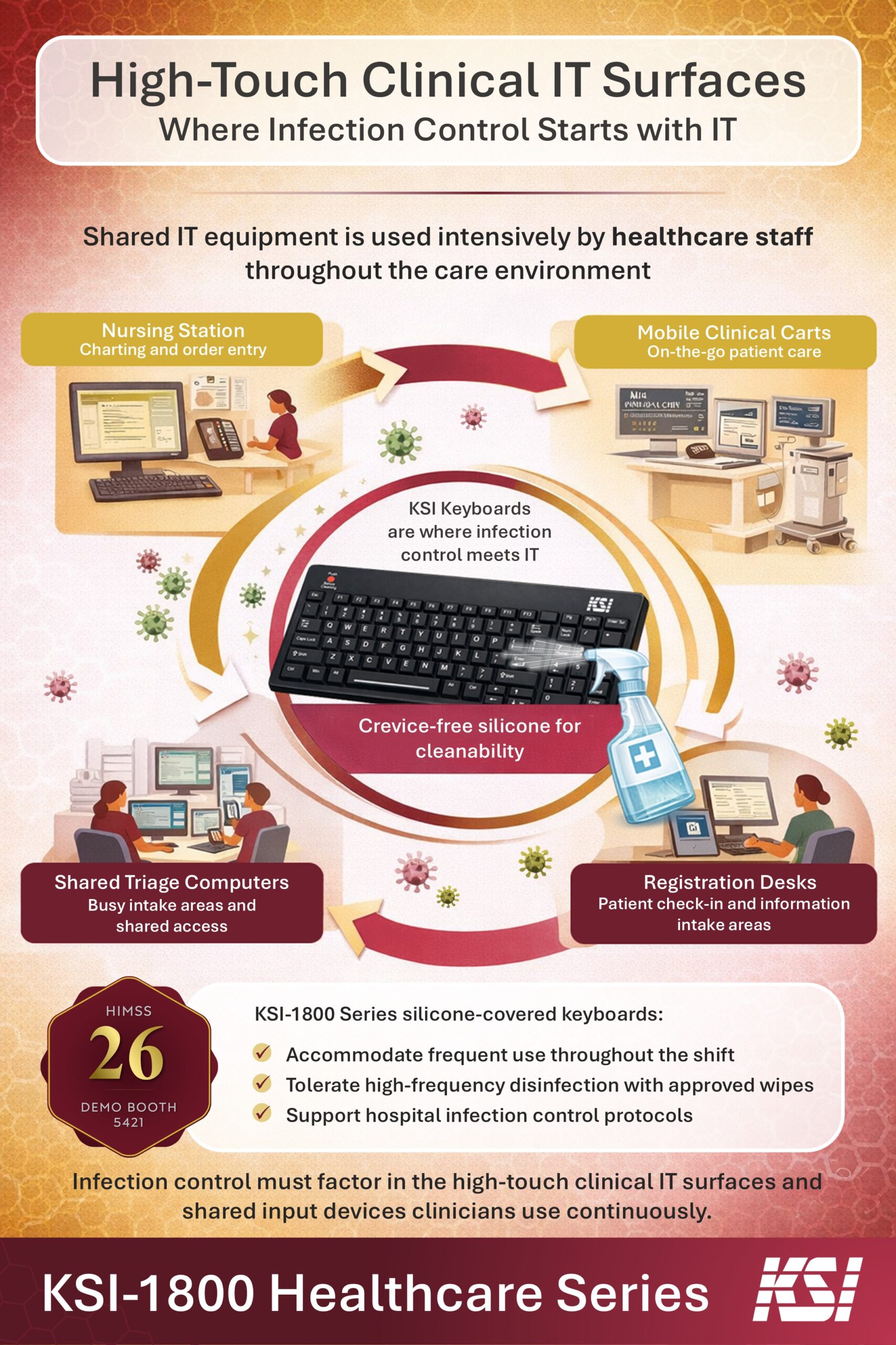
From nurse stations and medication carts to registration desks and exam rooms, keyboards are touched continuously by clinicians moving between patients, tasks, and workflows. These devices are essential to modern care delivery — but they also represent a frequently contacted surface within the clinical environment.
As healthcare organizations prepare for HIMSS26 and continue advancing digital workflows, infection control must extend beyond traditional medical equipment to include the IT devices that clinicians rely on every day.
Clinical Workflows Depend on Shared Input Devices
Healthcare delivery is increasingly digital and collaborative. Clinicians authenticate, chart, order medications, and document care across shared workstations throughout the shift.
These environments are characterized by:
- Multiple users per workstation
- Rapid transitions between patients
- Continuous device interaction
- Frequent movement across clinical zones
Unlike personal office keyboards, clinical workstations are rarely assigned to a single individual. They are shared tools embedded directly in care delivery workflows. Because of this, keyboards in healthcare settings experience repeated contact throughout the day — often between patient interactions.
The Infection Control Gap in Clinical IT
Healthcare organizations have well-established protocols for disinfecting medical equipment and high-touch room surfaces. However, traditional keyboards present practical challenges in infection-controlled environments:
- Keys and seams create crevices that are difficult to disinfect
- Liquids can damage standard electronics
- Cleaning often requires powering down or disconnecting devices
- Repeated wiping can degrade materials over time
These limitations can make routine cleaning less consistent, particularly in fast-paced clinical settings. As a result, keyboards may become an overlooked surface in infection control strategies — despite their frequent contact during care delivery.
Infection-Control-Ready Input Devices Support Clinical Hygiene
Healthcare-designed keyboards address these challenges by aligning device design with infection control practices. Features commonly associated with infection-control-ready keyboards include:
- Crevice-free surfaces suitable for disinfection
- Materials compatible with hospital-approved wipes
- Designs that tolerate frequent wiping
These characteristics allow keyboards to be cleaned as part of routine environmental hygiene without disrupting clinical workflows.
Clinical IT and Infection Prevention Are Converging
Infection prevention is no longer limited to traditional medical equipment. As care delivery becomes more digital, clinical IT devices are increasingly recognized as part of the care environment.
For clinical IT leaders, this creates a new consideration: Workstation hardware must support both digital workflows and infection control protocols.
This is particularly relevant in environments such as:
- Patient rooms
- Nurse stations
- Mobile clinical carts
- Procedure areas
- Registration and triage desks
In these settings, keyboards function as shared clinical tools rather than standard office peripherals.
Supporting Hygiene Without Slowing Care
Any infection control measure in healthcare must meet a practical test: it cannot impede care delivery.
Devices that require shutdown, disconnection, or complex handling to clean can create friction in busy clinical environments. Conversely, keyboards designed for healthcare use allow staff to disinfect quickly and continue working without interruption.
This alignment between hygiene and workflow is essential in modern clinical IT design.
Looking Ahead to HIMSS: Clinical Devices as Part of Infection Strategy
As healthcare organizations evaluate workstation security, identity workflows, and shared device management ahead of HIMSS, infection control considerations are increasingly part of the conversation. Secure access, clinician mobility, and device hygiene are interconnected elements of safe, efficient care environments. Infection control does not begin and end with hands or surfaces alone. It extends to the shared tools clinicians use throughout their day — including the keyboard.
Conclusion
Keyboards are among the most frequently touched devices in clinical environments. Ensuring they can be cleaned reliably and consistently supports broader infection control efforts without disrupting care delivery. As healthcare continues to digitize, clinical IT hardware must meet the same hygiene expectations as other high-touch equipment in patient care settings.
Infection control starts at the point of interaction. In modern healthcare workflows, that often begins at the keyboard.